


08 December 2025
Sermsang Power Elevates HRDD Mechanism to Encompass the Entire Value Chain, Driving Sustainable Business
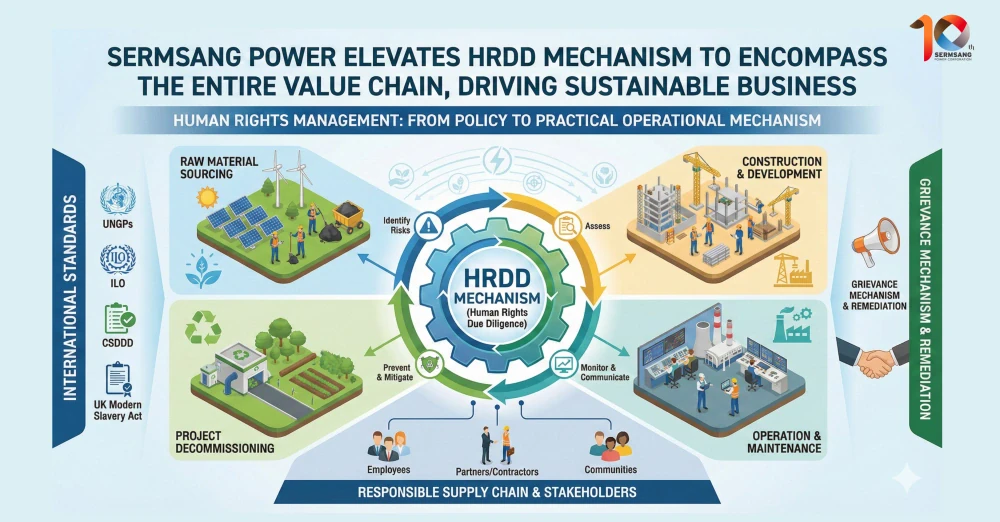
In a world where sustainability is the new business mandate, human rights management must transcend being mere “policy statements” to become “practical operational mechanisms.”
Sermsang Power Corporation (SSP) understands that the growth of the renewable energy business must go hand-in-hand with responsibility towards communities and society. Therefore, the Company has adopted Human Rights Due Diligence (HRDD) as its core operational framework, ensuring human rights management covers every dimension of the value chain—from raw material sourcing and construction to maintenance and power plant decommissioning.
What is HRDD and Why is it Critical for Sermsang Power?
HRDD (Human Rights Due Diligence) is a systematic human rights risk management process that enables the business to:
- Identify potential risks or impacts.
- Assess severity and likelihood.
- Prevent & Mitigate impacts in advance.
- Monitor & Communicate progress and performance transparently.
For Sermsang Power, this process applies to employees, business partners, contractors, and communities surrounding the power plants, ensuring that the business operates with respect for human rights at every level.
SSP’s HRDD Structure
Sermsang Power has developed a governance structure that integrates HRDD, HRRA (Human Rights Risk Assessment), and Responsible Supply Chain management. This structure adheres to the UN Guiding Principles on Business and Human Rights (UNGPs), ILO Core Labour Standards, the European Union’s Corporate Sustainability Due Diligence Directive (CSDDD), and the UK Modern Slavery Act 2015, ensuring that human rights risk assessment and management meet international standards.
Furthermore, the HRDD policy is integrated into the Code of Conduct, Anti-Corruption Policy, Safety, Health, and Environment (SHE) Policy. This ensures that all relevant parties—whether employees, partners, or contractors, operate under the same standards of transparency and accountability.
Implementing HRDD Across the Value Chain
Sermsang Power’s HRDD process covers both internal and external operations, starting with Supply Chain Management. Since the renewable energy business involves various partners, HRDD is utilized to verify and assess potential human rights risks, such as labor rights violations, discrimination, and community impacts. The process also references the Human Rights Risk Assessment (HRRA) to facilitate in-depth risk analysis, confirming that organizational operations are based on a transparent and verifiable Responsible Supply Chain.
During the project operation phase, SSP conducts human rights risk assessments annually, covering key stakeholders: employees, communities, partners, and contractors. The assessment results are used to monitor and continuously improve risk mitigation measures. This process is linked to the Corrective Action Plan and the Grievance Mechanism, which allows stakeholders to report human rights-related issues safely and verifiably.
Additionally, the 2024 Sustainability Report highlights the consideration of “technology sustainability at the end of the renewable energy project lifecycle.” This reflects SSP’s commitment to responsibly managing the long-term impacts of its business, particularly regarding local communities and the environment, ensuring operations align with international human rights standards throughout the value chain.
Grievance Mechanism and Remediation
A key component of HRDD is providing a space for affected voices to be heard. Sermsang Power has established a Grievance Mechanism accessible both internally and externally. Every case is treated fairly, with strict confidentiality for the whistleblower/complainant.
Conclusion
For Sermsang Power Corporation (SSP), the Human Rights Due Diligence (HRDD) process is more than a tool to prevent human rights violations; it is a responsibility management system that builds a foundation of transparency for the organization. Through annual human rights risk assessments and operations grounded in international standards such as UDHR, UNGC, UNGP, and ILO, SSP ensures that its renewable energy business grows sustainably while respecting human dignity at every stage of the value chain.